
Is Paris Still a Lovers’ Destination in 2026? What to Really Expect

No city carries expectations like Paris. Decades of films, novels, and honeymoon photos have built it into the official world capital of romance, which is exactly why the internet now overflows with the opposite content: “Paris is overrated,” “Paris syndrome is real,” videos of overflowing bins and hour-long Louvre queues.
So which is it? As of 2026, the honest answer: Paris absolutely still delivers for couples, but only for couples who plan around its flaws instead of pretending they don’t exist. Here’s the real picture.

What the Skeptics Get Right
Let’s concede the fair points first, because pretending Paris is flawless is how disappointments happen.
The icons are crowded badly. The Louvre, the Eiffel Tower, and Montmartre’s Sacré-Cœur operate at crush capacity much of the year. Turning up spontaneously means queues that devour half a romantic day; the Louvre without a timed reservation in peak season is simply a mistake.
It’s expensive, and casually so. Paris will happily charge you €8 for a mediocre tourist-zone coffee and €25 for a forgettable croque monsieur near the Eiffel Tower. Couples who eat and drink wherever they happen to be standing burn budgets fast.
“Paris syndrome” has a real kernel. The gap between filtered-Instagram Paris and actual Paris a huge, busy, sometimes gritty metropolis with litter, scammers around major sights, and locals in a hurry, genuinely startles some visitors. The city is not a film set.
What the Skeptics Miss
Here’s what the “overrated” videos never show: the Paris that works isn’t at the landmarks. It’s ten minutes’ walk from them.
The romance infrastructure is unmatched and much of it is free or cheap. A baguette-cheese-wine picnic on the Canal Saint-Martin or beneath the Eiffel Tower on the Champ de Mars costs less than an airport sandwich. Walking the Seine at night, when the bridges glow and the crowds thin, costs nothing. The passages couverts Paris’s ornate 19th-century covered arcades offer rainy-day wandering that feels like time travel.
Notre-Dame is back. Since reopening in late 2024 after its restoration, the cathedral has returned as one of the city’s most moving (and free) visits book the free timed entry online to skip the line.
The neighborhood game is eternal. Le Marais at dusk, the village lanes of Montmartre behind the basilica (rue de l’Abreuvoir, Place Dalida) at 8am before the crowds, the bookshops and cafés of the Latin Quarter, sunset from the steps of Sacré-Cœur or the free rooftop of Galeries Lafayette this is the Paris couples actually fall in love in, and mass tourism barely touches it.
Day trips multiply the magic. Versailles’ gardens, Monet’s gardens at Giverny (spring through autumn), and the champagne cellars of Reims are all easy rail trips that turn a city break into a story.
The Couples’ Playbook for 2026

Time it right. Late April–June and September–October hit the sweet spot of weather, light, and (relatively) saner crowds. August is when many Parisians leave and some beloved local spots close; deep winter is cheap, moody, and genuinely romantic if you lean into café culture.
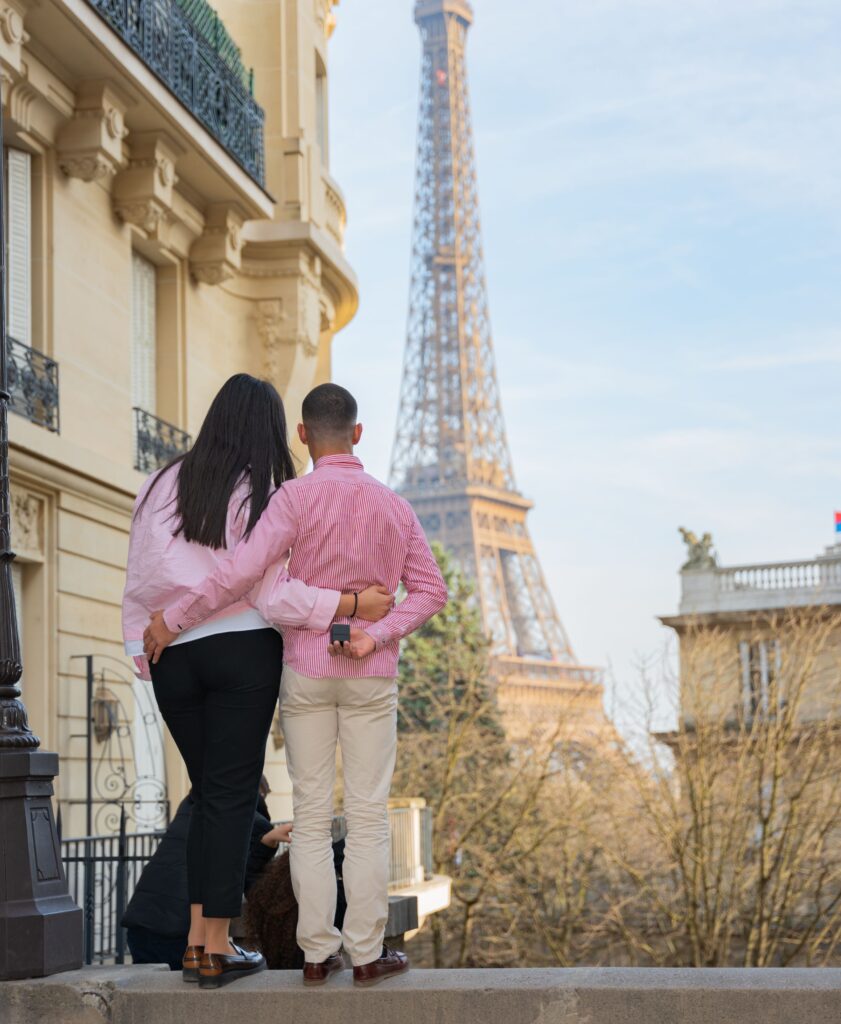
Book the big three in advance. Louvre (timed entry, go at opening or on evening openings), Eiffel Tower (book weeks ahead, or skip the tower itself the best views of the Eiffel Tower are from Trocadéro at sunrise or a Seine cruise at night, both of which include it in the frame), and Notre-Dame (free timed slots online).
Eat one street back. The unbreakable rule: never eat within sight of a major monument. Walk two blocks into a residential street and prices halve while quality doubles. Lunch is the luxury hack many excellent restaurants serve fixed-price lunch menus for a fraction of dinner rates.
Build in unscripted time. The best Paris moments, the accidental jazz bar, the bakery you smelled before you saw cannot be scheduled. Couples who itinerary every hour miss the entire point of the city.
Guard the practicalities. Pickpockets work the tourist zones and metro; use zipped bags and ignore anyone with a petition or a “gold ring.” Book accommodation in arrondissements 1–7, 9, or the Marais (3rd–4th) for walkability, or save money slightly further out near a metro line.
The Verdict
Is Paris still a lovers’ destination in 2026? Yes, arguably more than ever, precisely because the formula is now well understood. The couples who leave disappointed are almost always the ones who queued at noon for the Louvre, ate beside the Eiffel Tower, and expected a movie. The couples who leave engaged, anniversary-ed, or simply besotted are the ones who booked ahead, wandered the neighborhoods, picnicked by the river, and let the city be what it actually is: not a fantasy, but something better – real, and still the most romantic big city on Earth.
Frequently Asked Questions
- How many days do couples need in Paris? Four nights is the sweet spot, enough for the icons, the neighborhoods, and one day trip, without exhaustion.
- Is Paris safe for tourists? By big-city standards, yes. The main issue is pickpocketing and scams in tourist zones, not violent crime, basic awareness handles most of it.
- What’s the most romantic thing that costs nothing? The Seine at night, a sunset picnic on the Champ de Mars or Canal Saint-Martin, and early-morning Montmartre before the crowds arrive.
- Is the Eiffel Tower worth going up? Divisive. The view of the tower beats the view from it, many couples prefer Trocadéro at sunrise, the Arc de Triomphe rooftop, or a night river cruise, and skip the tower queues entirely.
Continuing the Europe trip? See Is the UK Still Worth It in 2026? and, for aurora-chasing couples, Northern Lights Season.